Track & Trace in the tobacco industry – background, rules and future

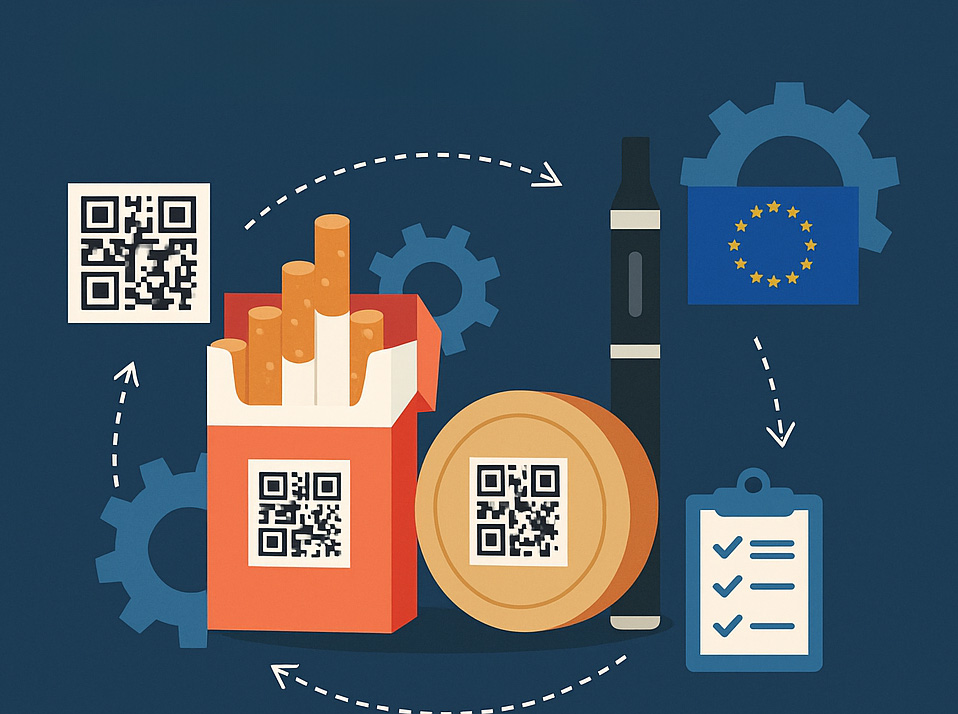
Table of Contents
Illicit tobacco products have long been a serious public health and economic problem. To address this growing threat, traceability – often called Track & Trace – has emerged as a powerful tool. The purpose is clear: to track every tobacco product throughout the supply chain and ensure that only legal goods reach the market.
Through unique ID codes and digital registration of each step, the systems make it possible to track origins, flows and deviations. The EU model is today one of the world's most comprehensive and has become a guide for other countries. But the development is not over - now traceability is also being discussed for new product categories such as white snus and e-cigarettes.
In this article, we review how traceability systems have evolved, what requirements apply within the EU, how the labelling itself works, which actors are covered – and why it is more important than ever to stay one step ahead.
Background: The illegal tobacco trade
During the 2000s, the illegal trade in tobacco products increased sharply, leading the international community to take action. To reduce smuggling and protect tax revenues, several initiatives have been taken – both globally and nationally.
Illicit Trade Protocol – a global agreement
In 2012, the World Health Organization (WHO) adopted the so-called Illicit Trade Protocol under the Framework Convention on Tobacco Control (FCTC). This became the first global agreement to require traceability of tobacco products. The protocol entered into force in 2018 and means that:
- All member states must introduce a track & tracesystem for cigarettes within 5 years (no later than September 2023).
- Other tobacco products will be covered within 10 years.
The goal is to create compatible, cross-border systems that secure the supply chain and facilitate the fight against smuggling.
Status: How far has the world come?
By August 2023, 67 countries had ratified the protocol – but many were lagging behind in implementation:
- Only 37 countries had then introduced a functioning traceability system.
- Around 20 countries, including EU Member States, use the EU model.
- Other countries apply their own solutions or systems based on tax stamps.
A coordinated global traceability system is now being developed to link these national and regional systems.
Turkey – first in the world with digital traceability
Already in 2007, Turkey was a pioneer in this area:
- Unique tracking codes were introduced on cigarette packages in July 2007.
- The system was based on digital tax stamps with invisible ink and 2D data matrix codes.
- All cigarette packs sold after November 2007 must have a code.
- Stores that sold uncoded products could be held liable and fined.
Turkey's successes have shown that digital traceability reduces smuggling and strengthens tax collection.
Developments in other countries and within the EU
Other major tobacco markets, such as China, have also introduced their own systems to combat counterfeiting and smuggling. In the EU, work on a common solution began in 2014, when the new Tobacco Products Directive was adopted. Five years later, in 2019, the EU became one of the first major regions to introduce a fully functioning traceability system for tobacco products.

EU rules for traceability of tobacco products
The EU introduced this comprehensive traceability system to combat the illicit trade in tobacco products. This is regulated by the Tobacco Products Directive (2014/40/EU), which sets clear requirements for labelling and monitoring.
Timeline for implementation
- 20 May 2019: Traceability requirements were introduced for cigarettes and roll-your-own tobacco.
- 20 May 2024: Other tobacco products are covered, including snuff, cigars and pipe tobacco.
- Temporary exemption: Products manufactured before May 20, 2024 may be sold without a code until May 20, 2026.
After these dates, all tobacco products without correct labelling are prohibited from being sold within the EU.
What does the EU traceability system mean?
The system is built around four pillars:
1. Unique identity marking
Every tobacco package must have a unique code (often a 2D DataMatrix) that shows where and when it was manufactured. The code is printed directly on the package by the manufacturer or importer.
2. Registration of movements
All actors in the supply chain – from manufacturer to store – must record every time a product changes location or ownership. The events are reported to a central data storage system.
3. Central database
Each manufacturer has a primary database, and the information is copied to an EU-approved secondary database. This database, managed by Dentsu International, provides authorities with real-time access to information.
4. Safety marking
In addition to the digital code, a physical security feature is required – such as a hologram or special tape – to show that the product is genuine and not tampered with.

Application in Sweden
- In Sweden it is The Public Health Agency who is responsible for the implementation of the system.
- All Soft Corp sro is Sweden's authorized ID issuer, and their code "QCALL" is found on all traceable products.
- The ID issuer must be independent from the tobacco industry, in line with EU public health principles.
Purpose of the system
The EU-wide system makes it possible to:
- Identify and track every tobacco product.
- Prevent the sale of counterfeit or illegal products.
- Protect tax revenues and support public health.
An updated regulation (EU 2023/448) entered into force in December 2023 and further strengthens the technical format – but the basic principle remains: full traceability to stop illegal trade.
Traceability outside the EU – a global overview
The trend is clear: more and more countries around the world are introducing systems for tracking tobacco products, often inspired by the WHO protocol against illicit trade.
Global development
- The WHO protocol requires traceability for cigarettes by 2023 and for other tobacco products by 2028.
- Implementation varies – high-income countries more often have established systems, while low-income countries face technical and economic challenges.
Europe outside the EU
- Great Britain and Norway introduced traceability at the same time as the EU.
- Switzerland and Russia developing its own systems in line with the WHO protocol.
Examples from other regions
- Brazil has had cigarette traceability for several years.
- China, India and Pakistan has introduced or is planning labelling and tracking.
- Kenya and South Africa is in the initial stages of implementation.
US position
- The US does not have a federal traceability system, but the debate is ongoing.
- Tax stamps are used, but lack digital functionality.
- In 2025, the American Lung Association called for the introduction of “track and trace.”
The role and regulation of industry
- Tobacco companies have tried to launch their own systems, such as Codentify.
- WHO and the EU require traceability systems to be independent from industry.
- International cooperation is underway to standardize data exchange between countries.
How a Track & Trace flow works
Track & Trace means that each tobacco package is given a unique code that makes it possible to follow the product's path from production to store. The code – often printed as a small 2D barcode – is generated by an independent ID issuer and contains information about the manufacturer, time and production line.
A typical flow includes:
- Unique marking: Each package is marked with a code that can only be used once.
- Verification: The code is scanned and checked in real time.
- Sequencing & aggregation: Products are grouped and digitally linked to cartons or pallets.
- Logistics tracking: Every transport and warehouse event is recorded – all the way to the first retailer.
All data is sent to approved databases where authorities can track and control the flow. The result is an unbroken, secure chain that protects against smuggling and mishandling.
Read more about how Track & Trace works here.
Who is covered by the traceability requirements?
EU traceability rules apply to the entire tobacco product supply chain. All operators handling tobacco – from manufacturing to sale – must be registered in the system and follow established procedures.
Actors who must be registered:
- Manufacturers in the EU
Has the main responsibility for:- Apply for ID codes for themselves, their factories and products.
- Label each package correctly.
- Report production and delivery to the traceability system.
- Importers from third countries
Equivalent to manufacturers. They must:- Label the products according to EU standards (if not already done).
- Register the import event in the system.
- Wholesalers and distributors
Must:- Have your own identity codes (EOID) and facility ID (Facility ID).
- Scan and report all outbound deliveries, including recipient ID.
- Retailer (first level of sales)
Don't need to scan sales to customer, but:- Must be registered with a facility ID.
- This is required for wholesalers to be able to report deliveries to the store.
Registration is done through an authorized ID issuer. If an ID is missing, it is not permitted to participate in the distribution – for example, a wholesaler is not allowed to deliver to an unregistered store.
What happens in case of non-compliance?
Authorities monitor compliance with the system – in Sweden, the Public Health Agency is responsible for supervision. Violations of the rules can have serious consequences:
Possible penalties:
- Sales ban and seizure
Products without proper labelling can be confiscated. A store can lose its entire inventory. - Fines and penalties
Injunctions and court decisions can lead to high fines – especially in the case of tax crimes. - Revoked permit
Repeated violations may result in companies losing their right to conduct tobacco business. - Criminal measures
In the case of serious crimes such as smuggling or counterfeiting, prosecution may be initiated.
A requirement to join
Following the traceability rules is not just a legal requirement – it is also a business requirement. Wholesalers do not cooperate with non-registered operators, and stores avoid products without approved labelling. The system is thus a level playing field for all serious players in the tobacco industry.
The future of traceability
The traceability system within the EU currently only applies to traditional tobacco products – such as cigarettes, rolling tobacco, cigars and snuff containing tobacco. However, developments clearly indicate that more product categories may be covered in the future.
What is covered today?
- Tobacco products with actual tobacco content are subject to EU traceability requirements.
- Tobacco-free nicotine products – such as white snus and e-cigarettes – are covered do not by the Track & Trace system.
- These products are regulated to some extent nationally (e.g. with age limits), but lack requirements for unique code marking or movement registration.
What can change?
- The European Commission is reviewing tobacco regulations within the framework of a “Tobacco-Free Generation”.
- It is possible that white snus and nicotine liquids will also be included in future traceability requirements.
- Public health organizations advocate coordinated regulation of all nicotine products.
Producers of new nicotine products should therefore stay updated – changes can come quickly.
Final words about Track & Trace
What started as an initiative to combat illicit trade has now grown into one of the world’s most advanced traceability systems. In the EU, Track & Trace is no longer an option – it is a legal requirement that affects every tobacco package. With unique ID codes and central data storage, the system has become a model for other regions, creating a more transparent and fairer market.
What does this mean for producers and traders?
- Adaptation is necessary, but it also opens up new business advantages.
- Traceability reduces the risk of smuggling and strengthens consumer protection.
- Brands that can guarantee authenticity gain trust.
Think ahead – also for new nicotine products
Although nicotine patches and e-cigarettes are currently outside the requirements, future legislation could quickly change that. Building the right infrastructure and knowledge now is a smart move – both for regulatory compliance and to stand stronger in the market.
Sources: